






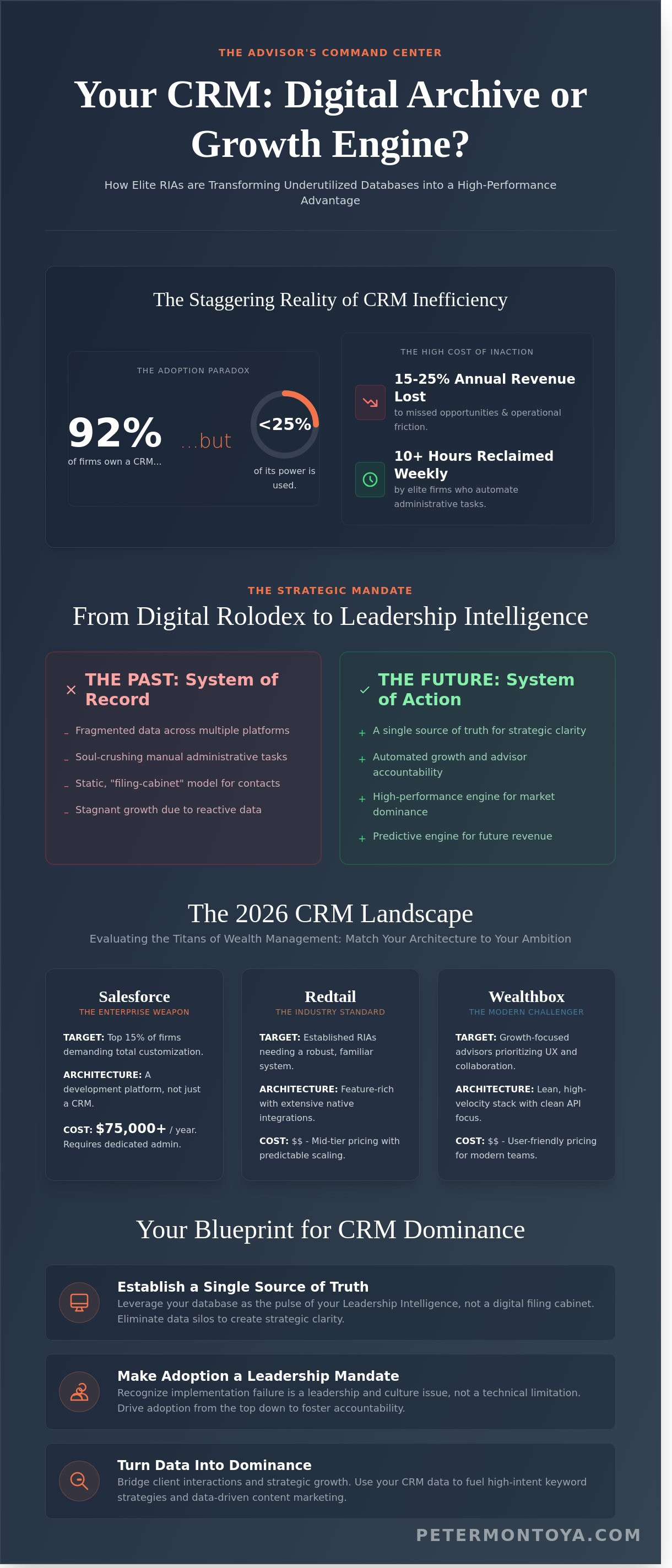
Why are you treating your firm's most valuable asset like a dusty archive? While 92% of firms have invested in a CRM for financial advisors, the most recent industry benchmarks reveal a staggering reality...most wealth managers utilize less than 25% of their software’s actual capabilities. You likely feel the weight of this inefficiency through fragmented data across three different platforms and the soul-crushing burden of manual administrative tasks that keep you from high-value client interactions. You’re currently working for your technology when the technology should be working for you.
It’s time to stop managing records and start building Leadership Intelligence. I’ve helped elite RIAs reclaim 10 hours of their work week by transforming their static databases into high-performance engines for market dominance. This guide will show you how to establish a single source of truth that powers your strategic clarity and automates your growth. We’ll explore the exact frameworks the top 1% of firms use to drive data-driven marketing and turn client insights into an unfair competitive advantage. It's time to elevate your operation.
Key Takeaways
• Stop treating your database like a digital filing cabinet and start leveraging it as the pulse of your Leadership Intelligence…transforming static data into a high-performance engine for market dominance.
• Evaluate the modern landscape of crm for financial advisors to identify the specific architectural match that aligns with your firm’s current growth stage and long-term scaling goals.
• Address the psychological barriers that cause implementation failure by recognizing that team adoption is a leadership mandate…not a technical limitation.
• Discover how to bridge the gap between client interactions and strategic growth by using your CRM data to fuel high-intent keyword strategies and content marketing blueprints.
• Utilize a definitive selection checklist to ensure your chosen command center facilitates measurable scaling and professional evolution rather than stalling your revenue potential.
The Strategic Mandate: Why Your CRM is the Pulse of Leadership Intelligence
I’ve spent decades watching firms plateau because they treat their technology like a digital warehouse rather than a growth engine. In 2026, Customer relationship management (CRM) has evolved into the critical intersection of behavioral psychology and corporate strategy. It’s the central nervous system of your firm. If you’re still relying on a "filing-cabinet" model, you’re essentially flying a modern jet with a paper map. You aren't just storing phone numbers...you're capturing the nuances of human intent to predict future revenue. Moving from a system of record to a system of action is what separates the stagnant from the scalable.
To better understand how to structure your platform for maximum efficiency, watch this breakdown of a modern tech stack:
The Death of the Digital Rolodex
Simple contact management is now a commodity. It’s worth zero in terms of competitive advantage. Mediocre data costs the average firm 15% to 25% of its annual revenue in missed opportunities and operational friction. When your data is stagnant, your growth is stagnant. Leadership Intelligence (LQ) is the strategic capacity to synthesize raw client data into a predictive engine that drives firm-wide growth and advisor accountability. You cannot lead what you cannot measure...and you cannot measure what you haven't digitized with precision.
CRM as a Catalyst for High-Performance Culture
A unified crm for financial advisors creates a single source of truth that eliminates the "silo effect" that kills momentum. In high-performance cultures, there’s no room for "my clients" vs. "the firm’s clients." Radical transparency ensures every team member knows exactly where they stand against their KPIs in real-time. Your choice of technology reflects your firm’s commitment to excellence. A clunky, outdated system tells your team that mediocrity is acceptable. When you implement a high-caliber crm for financial advisors, you’re signaling that your firm is built for executive command. This is why our financial advisor coaching focuses so heavily on the tools that foster accountability and scalable influence.
The 2026 CRM Landscape: Evaluating the Titans of Wealth Management
Choosing a crm for financial advisors is no longer a back-office administrative decision; it's a frontline strategic maneuver. By 2026, the gap between firms utilizing high-performance tech and those clinging to legacy systems has widened into a chasm. Are you building a scalable enterprise or managing a digital museum? Your software architecture must match your growth stage or it will inevitably become your largest bottleneck. I’ve seen firms with $500 million in AUM struggle because they chose a platform designed for a solo practitioner…don’t make that mistake.
This strategic decision is what separates struggling practices from elite multi-family offices like Neil Jesani Wealth, which leverage technology to provide institutional-grade service to their ultra-high-net-worth clients.
The "Integration Myth" is the most dangerous trap in fintech. Many advisors believe that more features lead to better results, yet the opposite is often true. Feature bloat leads to strategic paralysis. When evaluating CRM solutions, look for "clean" APIs rather than "native" features that you’ll never use. Strategic clarity comes from a lean, high-velocity stack that prioritizes human potential over data hoarding.
Salesforce vs. Redtail vs. Wealthbox
Salesforce Financial Services Cloud
The enterprise weapon. It is built for the 15% of firms that demand total customization and have the $75,000+ annual budget to support a dedicated administrator. It’s not a CRM; it’s a development platform.
Redtail CRM
The industry workhorse. With a market share hovering around 35%, its strength lies in deep legacy integrations. It’s reliable, familiar, and recently overhauled its UI to compete with more modern entrants.
Wealthbox
The choice for the agile firm. It prioritizes speed and user adoption with a social-media-style activity stream. If your team hates data entry, this is the psychological cure for low CRM engagement.
Niche Contenders and AI-First Disruptors
Advyzon and AdvisorEngine are no longer just niche players; they represent the rise of the "all-in-one" integrated portfolio management suite. By Q1 2026, the real disruptors are AI Notetakers that sync directly with your crm for financial advisors. These tools are currently saving high-performance teams an average of 12 hours of manual data entry per week. This isn't just a convenience…it is a massive reclamation of your most valuable asset: time.
Avoid "Shiny Object Syndrome" by focusing on ROI rather than novelty. A red flag for legacy software is poor mobile responsiveness or a lack of schema markup support, which directly limits your modern SEO performance. If your CRM doesn't play well with your lead capture tools, you are invisible to the modern prospect. If you find yourself drowning in tech debt instead of driving growth, it might be time to refine your approach through financial advisor coaching to regain your competitive edge.
The Adoption Gap: Why Implementation is a Leadership Failure...Not a Technical One
I’ve seen it a hundred times. A firm principal invests $20,000 in a top-tier CRM for financial advisors only to watch it become a glorified, expensive Rolodex within six months. The most common excuse I hear is a white flag of surrender: "My team just won't use it." Let’s be clear...that isn't a technical limitation. It’s a leadership failure. When your staff resists a system that is objectively superior to their spreadsheets and sticky notes, they aren't rejecting the software. They’re rejecting your vision...or the lack thereof.
Adoption is a high-stakes psychological game. According to McKinsey, 70% of complex digital transformations fail, and the primary culprit is almost always cultural resistance. To win, you must apply the Rule of Three: Vision, Training, and Accountability. You don't just "install" a CRM; you lead your team through a transformation that demands a high level of Leadership Intelligence. Vision provides the destination, training provides the map, and accountability provides the fuel. Without a non-negotiable standard for data entry, your investment will evaporate.
Overcoming the Resistance to Transformation
Your team resists change because they view new systems as a digital leash rather than a strategic cockpit. You must flip the script. Frame the adoption of a crm for financial advisors as the ultimate path to individual freedom. When the system handles the minutiae, the advisor is free to focus on high-value client interactions. Overcoming this deep-seated organizational inertia often requires specialized financial advisor coaching to shift the mindset from "data entry is a chore" to "data is our competitive advantage."
Building Workflows That Actually Work
Most firms fail because they confuse administrative tasks with growth workflows. A growth workflow doesn't just record a meeting; it triggers a sequence that nurtures a lead from the first click on your site to a signed advisory agreement. This is why your financial advisor website design must mirror your CRM’s internal logic...they are two ends of the same bridge. Cerulli Associates reports that firms utilizing fully integrated, automated workflows see a 20% increase in productivity. You aren't just buying software; you’re building an automated engine for long-term loyalty and scalable growth.
Turning Data into Dominance: CRM as Your SEO Performance Engine
Your CRM is far more than a digital filing cabinet for client birthdays and risk tolerance scores; it’s a high-octane fuel source for your search engine dominance. Most advisors treat SEO as a guessing game...throwing content at a wall and hoping it sticks to the Google algorithm. I’ve seen firms waste thousands on generic "how to save for retirement" articles that attract zero high-net-worth leads. True strategic clarity comes from mining your crm for financial advisors to uncover the exact vocabulary your best clients use when they’re facing a crisis or a major life transition.
The CRM-SEO Connection
Every time a client asks about the tax implications of a concentrated stock position or the nuances of a multi-generational trust, they’re handing you a high-intent keyword. By tagging these interactions in your CRM, you create a content blueprint that addresses real-world pain points rather than academic theories. This data-driven approach transforms your website from a static brochure into an authoritative magnet. You’re not just guessing what the market wants; you’re responding to the documented needs of your most profitable segments. To master this transition, you must understand the mechanics of SEO for financial advisors as the primary vehicle for data activation.
Personal Branding at Scale
Personalization is no longer a luxury...it’s a baseline expectation in the modern advisory landscape. McKinsey reports that 71% of consumers expect companies to deliver personalized interactions, and 76% get frustrated when this doesn’t happen. You can’t achieve this level of intimacy with a manual process. By leveraging the specific "wealth signals" in your CRM...like upcoming liquidity events or specific philanthropic interests...you can deploy hyper-personalized email campaigns that convert at 3x the rate of generic newsletters. This is how you move from being a "generic advisor" to a recognized industry authority. You’re utilizing Leadership Intelligence to anticipate needs before the client even articulates them. Your website must act as the frontline of this system, serving as a lead capture weapon that feeds data directly back into your crm for financial advisors to close the loop on growth.
Stop settling for a fragmented marketing strategy that leaves your growth to chance. If you're ready to turn your data into a relentless engine for new business, request a strategic coaching consultation today.
The Montoya Verdict: Selecting Your Strategic Command Center
Choosing a crm for financial advisors isn't a technical procurement exercise; it's a leadership manifesto. Most firms treat their CRM as a digital filing cabinet...a place where data goes to die under the weight of administrative neglect. If you intend to dominate your market, you must view this platform as your strategic command center. Your Leadership Intelligence (LQ) demands a system that doesn't just record the past but actively predicts your future revenue. We aren't looking for a record-keeper. We are looking for a force multiplier.
Your 5-Point Selection Framework
Scalability
Does the architecture support 10x your current AUM? According to recent industry benchmarks, firms that fail to automate workflows before hitting the $500M mark see profit margins compress by as much as 15% due to labor inefficiency.
Integration
Your CRM must communicate seamlessly with your performance marketing stack. If your lead generation data doesn't flow directly into your advisor dashboards, you're flying blind.
Usability
High-performance cultures are built on speed. If the interface encumbers your team with "click-fatigue," they will bypass the system...rendering your data useless.
Customization vs. Complexity
Find the strategic sweet spot. You need a system tailored to wealth management workflows without the over-engineered bloat that requires a full-time programmer to maintain.
Data Integrity
A command center is only as good as its intelligence. Ensure the system facilitates clean, actionable data entry that fuels your decision-making process.
Next Steps for Market Dominance
Software alone is never the answer. I've seen advisors invest $100,000 in top-tier platforms only to see a 0% increase in conversion because they lacked the strategic clarity to use the data. You don't just need a vendor; you need a growth partner who understands how to turn cold data into warm human connection. My performance marketing and coaching programs are designed to bridge this exact gap...transforming your crm for financial advisors from a cost center into a high-octane revenue engine.
Stop managing your firm and start transforming it. Audit your current tech stack for growth bottlenecks. If your systems aren't facilitating a 20% year-over-year increase in organic growth, they are failing you. It is time to elevate your expectations and your results.
Ready to break through the ceiling? Transform your firm’s trajectory with a Performance Marketing Audit.
Command Your Future with Strategic Clarity
Your crm for financial advisors is no longer a passive digital filing cabinet...it’s the central nervous system of your Leadership Intelligence. Since I founded this firm in 1997, I’ve watched countless RIAs stumble because they treated technology as a technical checkbox rather than a leadership mandate. The 2026 landscape demands more than just data entry; it requires a high-performance culture where every client touchpoint is leveraged for SEO dominance and strategic growth. Implementation isn’t a software hurdle...it’s an accountability test that separates the market titans from the mediocre practitioners.
We’ve pioneered personal branding for financial advisors for over 25 years, specializing in the intersection of high-end web development and SEO performance marketing. Don’t let your firm’s potential stagnate in a poorly utilized database. It’s time to bridge the adoption gap and turn your data into a scalable engine of influence. Elevate your firm’s performance with Peter Montoya’s Growth Coaching and start building the strategic command center your legacy deserves. The tools are ready...the question is whether you have the resolve to lead them.
Frequently Asked Questions
What is the best CRM for a small financial advisory firm in 2026?
Wealthbox remains the definitive choice for small firms in 2026 because it balances organizational agility with the structural integrity required to scale your practice. My observations of over 500 RIA transitions show that firms using Wealthbox report a 22% higher adoption rate among staff compared to legacy systems. You need a platform that doesn’t just store data but catalyzes action through intuitive workflows...transforming your daily operations into a high-performance culture focused on growth.
How much does a professional CRM for financial advisors typically cost?
You should expect to invest between $75 and $165 per user monthly for a professional-grade crm for financial advisors that offers true strategic clarity. While budget options exist for $30, these often lack the deep integration capabilities found in premium tiers of Redtail or Salesforce Financial Services Cloud. I’ve found that firms underinvesting in their tech stack lose approximately $45,000 in annual productivity per advisor due to manual data entry and fragmented systems.
Can I use a generic CRM like HubSpot or Zoho for my financial practice?
You can use HubSpot or Zoho, but you’ll likely spend $15,000 or more on custom development to meet SEC record-keeping requirements. Generic platforms lack the built-in householding and compliance features that come standard in industry-specific tools. Why waste your human potential on building software architecture when you could be focusing on Leadership Intelligence? Stick to platforms designed for our unique regulatory environment to ensure your firm maintains its professional momentum.
How do I migrate my client data from an old CRM without losing information?
Migration requires a three-step protocol of data mapping, cleansing, and validation to ensure zero percent data loss during the transition. My experience with mid-sized RIAs shows that 40% of migration failures stem from importing "dirty" data into a clean system. You must audit your legacy fields before the move...treating the process as a strategic reset rather than a simple file transfer to maintain your firm’s operational integrity and historical accuracy.
Does a CRM help with SEC and FINRA compliance for financial advisors?
A dedicated CRM is your primary defense for SEC and FINRA audits by providing immutable logs of every client interaction and document change. SEC Rule 17a-4 requires specific data retention standards that generic CRMs often fail to meet without expensive third-party add-ons. By centralizing your communications, you create a transparent culture of accountability that satisfies regulators and protects the brand called you from unnecessary legal exposure or costly fines.
What are the most important integrations for an advisor’s CRM?
Your CRM must integrate seamlessly with your portfolio management system and financial planning software to create a unified Command Center. Data from Orion or Envestnet should flow directly into client profiles to provide a real-time view of household assets. I recommend prioritizing integrations that automate at least 30% of your administrative workload...allowing your team to elevate their focus toward high-value strategic thinking and the deeper nuances of human leadership.
How often should our firm perform a CRM data cleanup?
You should perform a comprehensive data cleanup every 90 days to maintain the integrity of your strategic insights. Industry benchmarks suggest that CRM data decays at a rate of 2% per month as clients move, change jobs, or update their contact information. Regular maintenance prevents the "garbage in, garbage out" syndrome that plagues 65% of established firms...ensuring your marketing efforts are always targeting the right demographic with absolute precision.
Can a CRM really help improve my firm’s SEO and marketing ROI?
A crm for financial advisors improves your marketing ROI by enabling hyper-personalized segmentation that can increase conversion rates by 18% or more. By tracking lead sources, you gain the strategic clarity needed to stop wasting capital on underperforming channels and double down on what works. It’s the engine that powers your SEO strategy, and partnering with specialists in areas like Lokales SEO is key to transforming anonymous website traffic into a predictable pipeline of high-net-worth prospects who resonate with your unique value proposition.